Many mobile applications contain proprietary information such as original code, unique algorithms, cryptographic keys, API credentials, and business logic.
IP protection
Protect your mobile app's unique IP. Prevent attackers from extracting proprietary algorithms and business logic, which can lead to serious harm:

Unprotected mobile apps leave your competitive advantage exposed to threat actors equipped to download, analyze, and reverse engineer your work.

Make decompiled code unreadable so attackers cannot clone proprietary AI/ML models or core app mechanics.

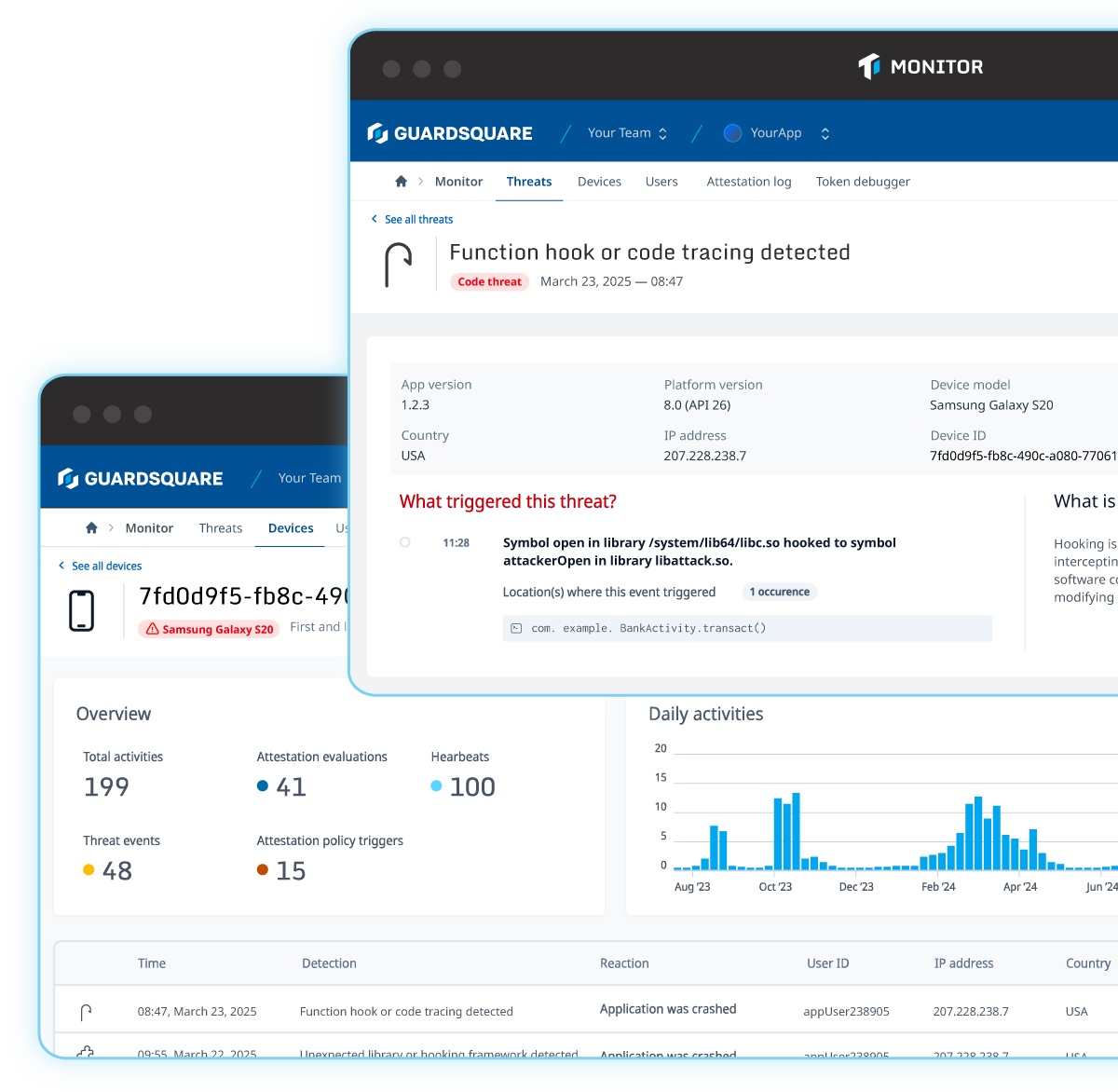
Stop function hooking and runtime instrumentation that target your fraud detection rules and algorithms during execution.

Ensure your API keys, endpoints, and credentials are not exposed in the code, and prevent unauthorized access to backend services.
Defend against reverse engineering attacks that lead to malicious clones, tampering, or theft of proprietary mobile app functions. Apply in-depth, multilayered protections to your code with techniques such as string encryption, name obfuscation, and control flow obfuscation.
Dynamic protections activate at runtime to detect hostile environments and block extraction attempts in real-time. Automatically block rooted or jailbroken devices and act against anti-debugging tools or tampering attempts. Runtime checks also protect your IP and sensitive logic against memory scraping and hooking attacks.
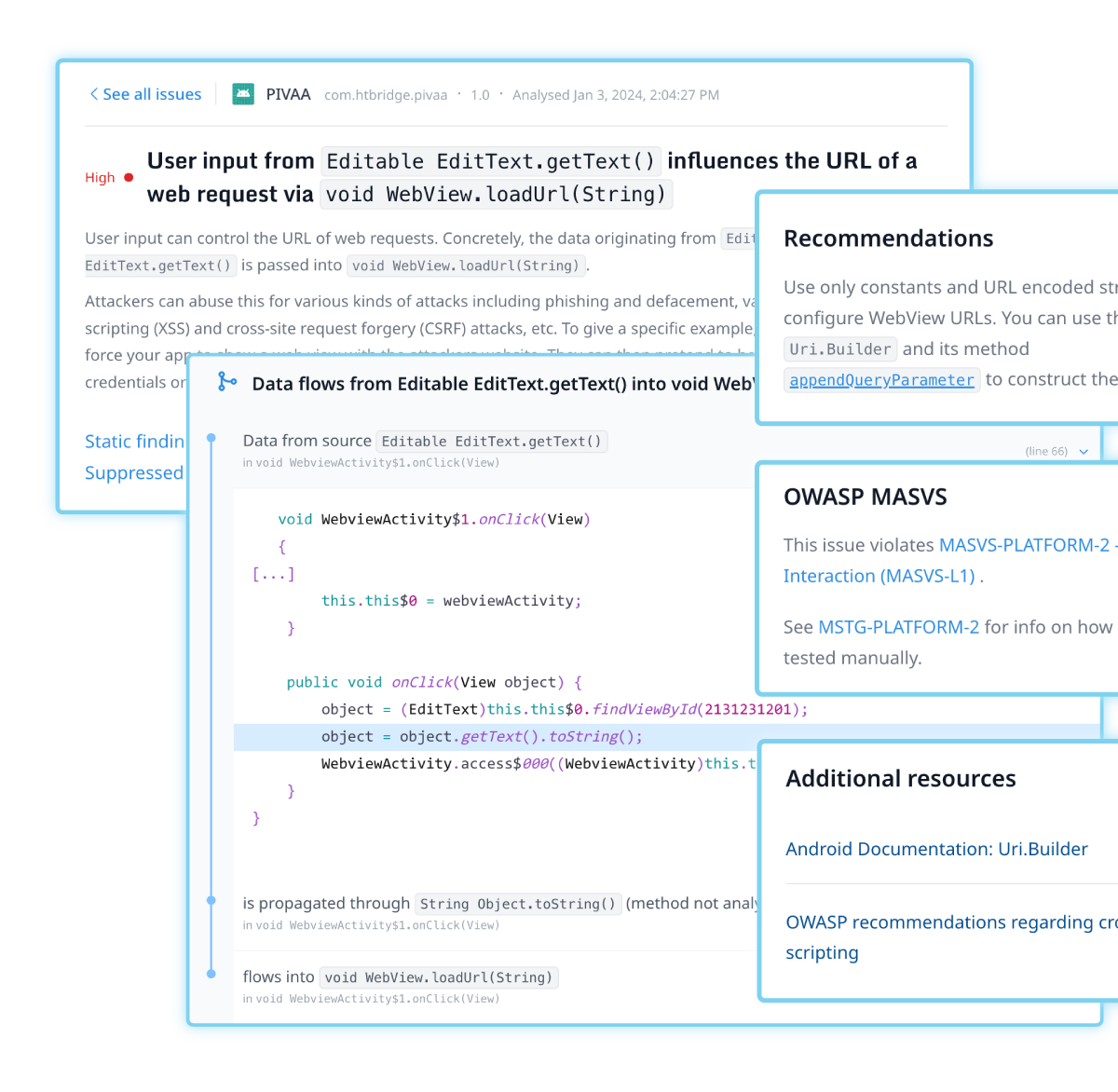
AppSweep continuously scans for security issues that could lead to IP exploitation with every mobile app build.
Guardsquare’s approach combines static (SAST) and interactive (IAST) mobile application security testing. Results align with OWASP MASVS standards, allowing you to prioritize fixing high-impact vulnerabilities, with provided actionable recommendations for each issue.
Shift security left without slowing down time-to-market:
Seamless integration with CI/CD pipelines
Unlimited scans
Unlimited team members with access
DexGuard’s defenses against static and dynamic analysis reinforce one another, providing more robust Android app protection overall than any individual approach would offer. When a malicious user runs your app from a debugger or emulator to validate their static analysis, automated RASP checks kick in allowing you to take actions like end the user's session, crash the application and deploy other defensive actions. DexGuard obfuscates each of these checks, preventing an attacker from learning where and how the application is detecting integrity violations.
DexGuard (Android) and iXGuard (iOS) secure apps and SDKs with compiler-based code hardening. This includes advanced techniques like data encryption, control flow obfuscation, and name obfuscation.
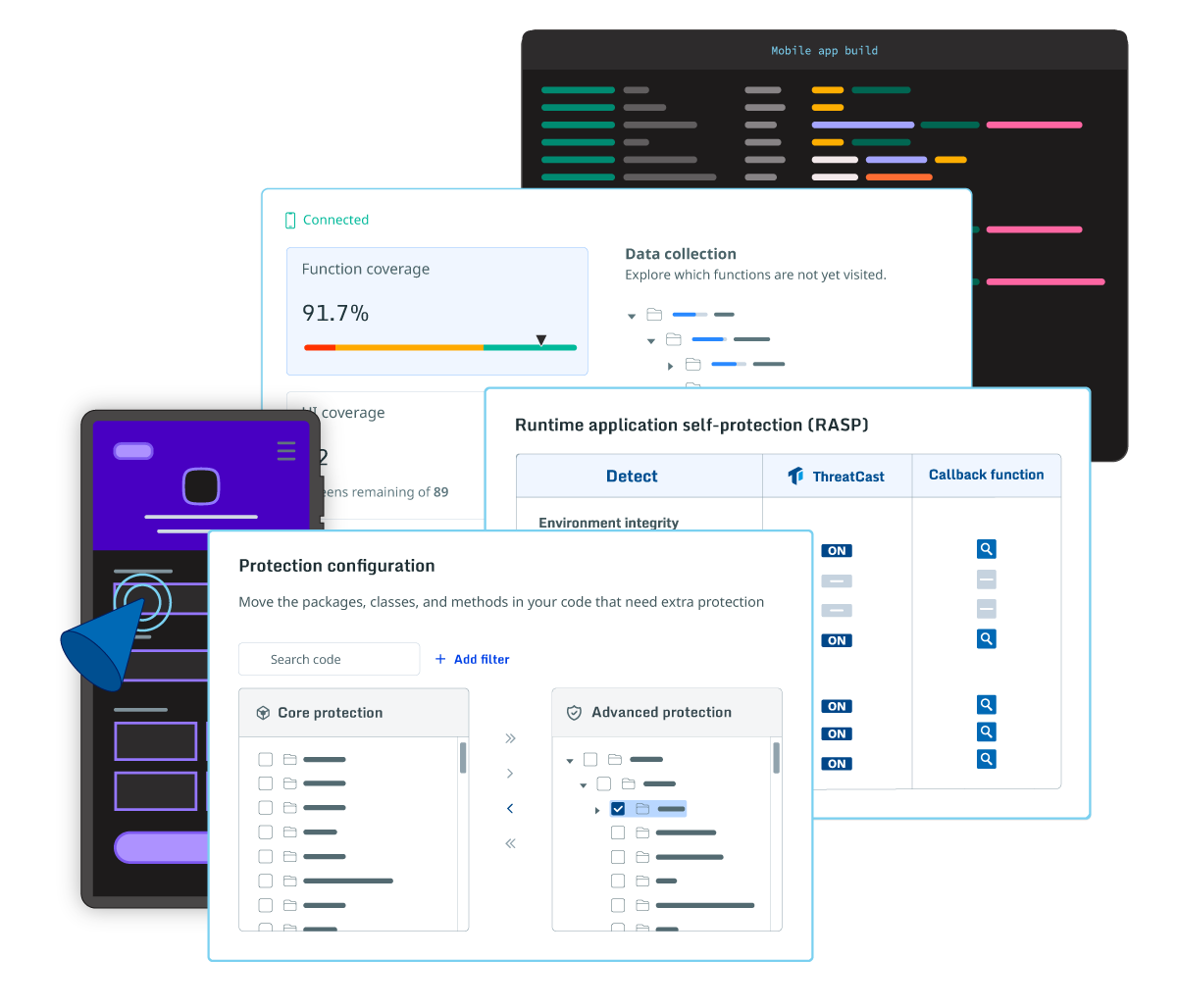
Guardsquare’s integrated runtime application self protection (RASP) checks detect tampering attempts from debuggers, function hooks, and dynamic instrumentation.
Get a protected build in < 1 day
Compatible with React Native, Flutter, Unity, and more
Helps meet compliance standards (e.g., GDPR, PSD2, PCI)
If each of your app’s builds apply the same defenses in the same locations, an attacker will easily decipher your app’s internal logic and will know where the most sensitive information lies. That’s why DexGuard hardens broad swathes of your app’s code and draws on a diverse library of integrity violation checks to prevent an attacker’s progress.
Because these code hardening and RASP techniques are applied polymorphically and automatically, no two builds feature the same protections. Thus, every build resets the clock on attackers, rendering their previous knowledge useless.
ThreatCast monitoring capabilities help you detect emerging attack patterns and suspicious users or devices in real-time.
Guardsquare threat monitoring captures precise telemetry showing which RASP checks are triggered, on which devices, and for which versions of your mobile app.
Dedicated app attestation capabilities ensure that any app calling your mobile APIs at runtime is authentic, while blocking malicious clones, bots, scripts, and agents. You can also adjust API security policies on-the-fly without needing to rebuild the app.
Achieve the highest level of protection while ensuring app stability and performance through Guardsquare's instrumentation and profiling
Experience easy implementation with a guided configuration that simplifies the entire workflow.
Get maximum mobile app protection with build history and protection reports that facilitate intuitive collaboration across security and dev teams through enhanced visibility and actionable insights.
Many mobile applications contain proprietary information such as original code, unique algorithms, cryptographic keys, API credentials, and business logic.
Static obfuscation makes code harder to read and reverse engineer, while runtime protection actively detects and responds to tampering attempts during execution.
Guardsquare’s solutions minimize app bloat and optimize performance.
DexGuard (Android) and iXGuard (iOS) combine multiple protection layers to make reverse engineering economically infeasible.
Advanced techniques include obscuring code structure, encrypting critical assets, and detecting attempts to extract or analyze proprietary logic.
Guardsquare’s reinforced layers of protection work together to increase the effort required for repackaging, including code hardening, anti-tampering mechanisms, and integrity verification that detect modified or redistributed builds.
Most customers have their initial protected build within a day, thanks to Guardsquare's guided workflow that tailors protection to your specific app instead of applying a generic template.